As regular CFZ-watchers will know, for some time Corinna has been doing a column for Animals & Men and a regular segment on On The Track... particularly about out-of-place birds and rare vagrants. There seem to be more and more bird stories from all over the world hitting the news these days so, to make room for them all - and to give them all equal and worthy coverage - she has set up this new blog to cover all things feathery and Fortean.

Thursday, 25 September 2014

Peacock's train is not such a drag afterall: Flight unchanged with and without plumage

Date:
September 17, 2014

Source:
University of Leeds

Summary:
The magnificent plumage of the peacock may not be quite the sacrifice to love that it appears to be, researchers have discovered. "These feathers weigh about 300g and can exceed 1.5m, so it's expected that the male birds would be making a significant sacrifice in their flight performance for being attractive," one researcher said. However, experiments showed that in fact, the plumage made no difference to take-off and flight of the birds.

Wednesday, 24 September 2014

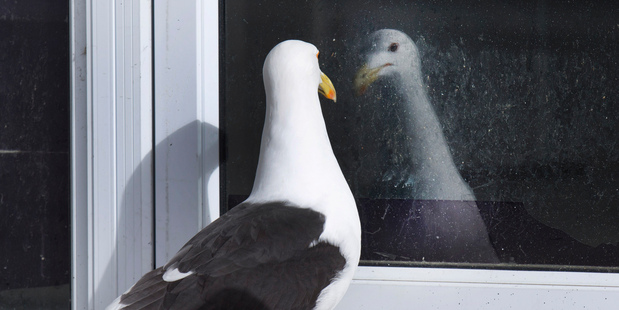
Bewildered bird falls in love with its own reflection

By Nikki Papatsoumas
3:53 PM Wednesday Sep 17, 2014

A bewildered bird has entered into a very one-sided relationship after falling in love with its own reflection.
A seagull pecking at its own reflection
 on a tinted-glass door of a disused factory 
in Waikanae on the Kapiti Coast. 
Photo / Mark Mitchell
The narcissistic seagull has taken up residence at an abandoned building on Omahi St in Waikanae on the Kapiti Coast, north of Wellington.

Carolyn Mitchell, owner of nearby business The Pantry, said the seagull has been there for the last two days, tapping at its reflection all day long.

Ms Mitchell said at first she thought the seagull might have had a mate trapped in the abandoned building.

"But then we realised no, he's actually seeing his reflection, and it is like he thinks it's a mate and he is actually trying to get food in there."

The bird had also begun to gather things to build a nest, Ms Mitchell said.

RARE AND EXOTIC BIRDS STOLEN FROM PARK

Visayan tarictic hornbills17th September 2014
On Monday night, thieves stole more than 30 very rare birds from the Avifauna bird park in Alphen aan den Rijn. According to the animal park, the thieves knew what they wanted and specifically took the valuable and rare breeding pairs. 

Thieves took several toucans, mynas and some parrot species as well as diverse hornbills. These hornbills seemed especially important to the robbers, as they took a total of 16 of the tropical bird species.

Among these hornbills, there were some very rare endangered species such as the white-crowned hornbill, Tickell’s brown hornbill and the very close to extinction Visayan tarictic hornbill. Avifauna writes on their website that these last birds need specialized care, and are only found in a select number of zoos in the world.

Migratory Bird Shot On Road - What Can Be Done To Prevent It?


KUWAIT CITY, Sept 16: The magnificent and statuesque Demoiselle Crane (Grus virgo) is a soaring migratory bird and is considered a vagrant in Kuwait, with only 8 confirmed records for this species. The first record was of 4 birds in 1954 and the last record was of 3 birds in 2012, so they are certainly not common nor annual visitors to Kuwait.

Demoiselle Cranes migrate in large flocks on a narrow front via specific routes and may travel vast distances without alighting to rest or feed. The autumn migration begins in late summer and generally they would only pass by on thermals high overhead, but occasionally bad weather or strong headwinds would force them to land to rest.

Like many other migratory birds, Demoiselle Cranes are under threat from habitat loss and degradation from agriculture across its range, as well as building of dams and drainage of wetlands, but also from shooters along their migration route and this was brought to light just this week, right here on our doorstep.

About 2 days back a single young (juvenile) Demoiselle Crane is observed walking along the pavement near TGIF on Gulf Road in Kuwait - it is probably exhausted and has been separated from the flock - but it appears to be walking and feeding oblivious to the cars rushing by on this very busy road.

Probably not many motorists even noticed this magnificent crane and what is (was) the 9th record of this species for Kuwait, but there were a few that did notice and admire a bird that they would probably never have seen before.


Tuesday, 23 September 2014

White Stork from reintroduction scheme in Italy, shot in Malta on first migration

BY GOZO NEWS · SEPTEMBER 17, 2014

Update: BirdLife Malta has discovered that the flock of ten White Storks that has been in Malta since Monday includes storks from a conservation reintroduction project in Italy.

“The flock was targeted on Tuesday in Marsa, with one of the birds killed bearing a colour numbered ring. The White Stork is part of a flock originating from a re-introduction scheme set-up in Udine, North East Italy, and was on its first ever migration south to the Africa.”

When the White Storks arrived on the mainland from Comino on Monday, they landed on a crane in Marsa, attracting many local bird watchers and photographers.

BLM said that 3 of the flock were seen to have coloured rings on their legs, a process carried out to monitor the birds’ movements from a distance. Birdwatchers, using telescopes, were able to read the details on two of the rings, IAB PA190 and IAB PA200, the details of which were sent to the Italian ringing scheme to confirm the origin of the birds.

Audubon Fights to Save the Piping Plover

By NICK DIVITO 

BROOKLYN (CN) - Efforts to shore up Fire Island and prevent more damage in the wake of Hurricane Sandy threaten the "survival and recovery" of the threatened Atlantic Coast piping plover, the National Audubon Society claims in Federal Court.

The Army Corps of Engineers plans to preserve the coast by building a series of sand dunes and berms along 19 miles of the Fire Island shoreline in Long Island.

The Audubon Society claims that the project "will result in immediate and long-term significant adverse impacts on piping plover habitat."

Audubon claims the federal government failed to "properly consider" the "cumulative impacts on piping plovers," nor did it objectively study all alternatives.

The group has "long advocated" for the piping plover's protection on Long island and Fire Island.

The group identified the area as an "Important Bird Area" in 1998, and reaffirmed that designation in 2005.

It hired a full-time biologist in 2009 to "help steward piping plovers on Long Island by installing predator enclosures and string fencing around piping plover nests, and advising beachgoers and managers on how to avoid negative impact to plovers," according to the lawsuit.

The group submitted its objections to the government's plan to install the berms on Fire Island in April, and asked for alternative measures to protect the birds.

It says that 1,615 of its members formally submitted comments to the Corps of Engineers critiquing the project, and that it met with Wendi Weber, U.S. Fish and Wildlife northeast region director, to "discuss concerns about the impacts" of the project.

Chicks starving in Newfoundland as warmer sea water imperils food supply for birds

Northern gannets are good parents. The seabirds mate for life, lay just one egg a year and dutifully feed and protect their chick until it leaves the nest in September.

But this year, thousands of gannets on Newfoundland’s south coast — on North America’s most southern gannet colony — abandoned their nests during the last few weeks of August. Many of the hungry chicks soon began tumbling off rocky cliffs and into the sea.

“It’s shocking,” says Bill Montevecchi, a biologist at Memorial University who describes it as one of the strangest events he has witnessed in his more than 30 years studying the seabirds. But, then, so too was the sea water near the colony that was several degrees Celsius above normal in August and appears to have triggered the abandonment.

It could be a harbinger of things, say scientists at the Audubon Society who have made the bold prediction that climate change could “imperil” nearly half of North America’s birds by the end of the century.

“It’s not so much that the adults are just going to die, but that they’ll not be able to successfully raise enough young to replace themselves over succeeding generations,” says biologist Gary Langham, lead author of Audubon’s grim forecast.