As regular CFZ-watchers will know, for some time Corinna has been doing a column for Animals & Men and a regular segment on On The Track... particularly about out-of-place birds and rare vagrants. There seem to be more and more bird stories from all over the world hitting the news these days so, to make room for them all - and to give them all equal and worthy coverage - she has set up this new blog to cover all things feathery and Fortean.

Tuesday, 6 January 2015

Escaped emu turns motorists' heads running on Israel roadway

HERZLIYA, Israel (AP) — Israeli traffic this weekend was really for the birds.
In the central Israeli town of Herzliya near Tel Aviv, an escaped emu ran through traffic Sunday on a main road between cars in the rain. Local authorities say the bird escaped from a private farm.
Passer-by Iliya Zelser filmed the bird's run. He says the experience made him feel like he was in a cartoon.
Zelser says he expected to hear the "beep beep" of the cartoon Road Runner.

Global bird conservation could be four times more cost-effective

Date:
January 5, 2015

Source:
Imperial College London

Summary:
Targeting conservation efforts to safeguard biodiversity, rather than focusing on charismatic species, could make current spending on threatened birds four times more effective, a new study has shown.

Monday, 5 January 2015

Sea bird die-off puzzles scientists

POSTED ON JANUARY 4, 2015
The Associated Press


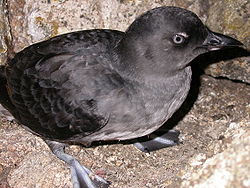
Cassins Auklet.jpgSALEM, Ore. — Scientists are trying to figure out what’s behind the deaths of seabirds that have been found by the hundreds along the Pacific Coast since October.

Mass die-offs of the small, white-bellied gray birds known as Cassin’s aucklets have been reported from British Columbia to San Luis Obispo, Calif.
It’s normal for some seabirds to die during harsh winter conditions, especially during big storms, but the scale of the current die-off is unusual.

“To be this lengthy and geographically widespread, I think is kind of unprecedented,” Phillip Johnson, executive director of the Oregon Shores Conservation Coalition, told the Salem Statesman Journal. “It’s an interesting and somewhat mysterious event.”

The birds appear to be starving to death, so experts don’t believe a toxin is the culprit, said Julia Burco, a wildlife veterinarian for the Oregon Department of Fish and Wildlife.

But why the birds can’t find food is a mystery.

RSPB Mull Officer ‘heartbroken’ to have lost ‘medical miracle’ sea eagle Kellan


A young sea eagle, Kellan, released in Mull four years ago,by RSPB Scotland after major injuries has just been found dead. Kellan, who had been hailed as a ‘medical miracle’ by wildlife experts and was known to followers around the world, has been found dead on the Isle of Mull. His remains were discovered by chance by a hill walker on Mull over the Christmas holidays.

Kellan was hatched at a nest on the island of Mull – known to millions of Springwatch viewers as Eagle Island – in 2010. He took his first flight during that summer. But within a few weeks he was found on the ground, badly injured, by a local farmer, was rescued by the RSPB and later taken into long term care by the Scottish SPCA.

After X-rays, Kellan was found to have a badly broken wing and a broken leg, injuries possibly sustained during a misjudged landing following his first flights. He was also seriously underweight and malnourished having been unable to hunt and feed.

He underwent major operations to correct the injuries to his wing and was overseen by specialist vets who usually work on exotic animals at Edinburgh Zoo and overseas. He was in captivity at the SSPCA Wildlife Rehabilitation Hospital for three months – looked after personally by Colin Seddon – before being considered fit and healthy for release back into the wild.

Scottish landowner attacks "out of control" RSPB

John Mackenzie erects signs making clear the RSPB is not welcome on his estate in protest at the charity's accusations over raptor poisonings, planning developments and policies for protecting capercaillies.

By Simon Johnson, Scottish Political Editor

4:40PM GMT 04 Jan 2015

One of Scotland’s largest landowners has erected signs across his estate stating the Royal Society for the Protection of Birds is not welcome in protest at the charity having “lost the plot” and abused its power.

John Mackenzie, who owns the 60,000 acre Gairloch and Conon Estates at Dingwall in Ross-shire, said “years of frustration and anger” had boiled over in response to the charity “constantly” blaming farmers, gamekeepers and landowners for raptor poisonings.

The signs were also erected in support of a campaign against a £9.6 million field centre and observatory being planned for the RSPB’s Forsinard Flows nature reserve in Caithness and Sutherland, with some protesters also erecting signs stating: “RSPB not welcome here.”

Mr Mackenzie said the RSPB was “out of control” and was pandering to the “less informed” for financial reasons. He said he hoped the signs would make the charity think again and encouraged other landowners on both sides of the Border to follow suit.

Sunday, 4 January 2015

Indian Skimmer fighting for survival at last stronghold of Chambal river

INDORE: Indian skimmer, an endangered species, is fighting for survival at its last stronghold, Chambal River, which is its only breeding ground. Sand mining and illegal fishing have become a major threat to survival of this fresh water bird whose colonies are now confined to banks of Chambal river. 

The colourful bird, with a black cap and orange bill, was once widely found around major rivers and sanctuaries. Now, it's mainly seen in and around parts of National Chambal (Gharial) Wild .. 


Once in a lifetime Gull spotted in Quincy

QUINCY, Ill. (WGEM) -

Bird enthusiasts from all over the Midwest descended upon Quincy Saturday to get a glimpse of the extremely rare Ivory Gull. 

"It's a fairly small gull but very elegant, pure white with very dark eyes and legs, with this cute little bill that's dark with a yellow tip on it," biology professor Jim Mountjoy said. 

It was rainy, cold, and damp. But that didn't stop Knox College Biology Professor and bird expert Jim Mountjoy from getting a glimpse of the Ivory Gull. He says the bird is a native of the high Arctic Islands and is rarely seen in the lower 48.

"This is an exceedingly rare bird to spot this far south," Mountjoy said. "Anywhere in the continental United States it's pretty hard to see, even if you go to Alaska it's sometimes quite difficult."

Mountjoy says he's been bird watching for over 40 years, and has only spotted the Ivory Gull one other time. He calls Saturday a very rare sighting in the state of Illinois.

"In 1991 there were two records of the Ivory Gull in Illinois and those were the only two well accepted records," Mountjoy said.