As regular CFZ-watchers will know, for some time Corinna has been doing a column for Animals & Men and a regular segment on On The Track... particularly about out-of-place birds and rare vagrants. There seem to be more and more bird stories from all over the world hitting the news these days so, to make room for them all - and to give them all equal and worthy coverage - she has set up this new blog to cover all things feathery and Fortean.

Wednesday, 3 June 2015

Bird with Flashy Tail Was 1st of its Kind on Ancient Supercontinent

by Laura Geggel, Staff Writer | June 02, 2015 11:00am ET

About 115 million years ago, a teenage bird with spotted, ribbonlike tail feathers flew around the trees of the supercontinent Gondwana, until it perished and fossilized in what is now northeastern Brazil, a new study finds.

At 5.5 inches (14 centimeters) from head to tail, the hummingbird-size fossil is the first of its kind to be uncovered in South America, and one of the oldest known bird fossils from Gondwana, a supercontinent that once encompassed Africa, Antarctica, Australia, India and South America, the researchers said.

What's more, it's one of the most complete and well-preserved fossils of a bird with ribbonlike tail feathers from the Early Cretaceous period, and gives researchers an unprecedented view of the intriguing plume that adorned its derriere. [See images of the remarkable bird with ribbonlike tail feathers]

Tuesday, 2 June 2015

Arctic ducks combine nutrients from wintering, breeding grounds to grow healthy eggs


Date:
May 20, 2015
Source:
Central Ornithology Publication Office
Summary:
It takes a lot of nutrients to build an egg. One of the big questions among researchers who study the eggs of migratory birds is where those nutrients come from -- does the mother make the egg directly out of what she eats during the breeding season, or does she save up nutrients consumed on her wintering grounds? The answer appears to be both for Common Eiders, large, sea-going ducks that breed in the Arctic.
Continued ...

Social structure 'helps birds avoid a collision course

'Date: May 21, 2015

Source: University of York

Summary: The sight of skilful aerial maneuvering by flocks of Greylag geese to avoid collisions with York's Millennium Bridge intrigued a mathematical biologist. It raised the question of how birds collectively negotiate human-made obstacles such as wind turbines that lie in their flight paths.

One to ovoid? Using 3-D printing, researchers can study what causes birds to reject eggs with greater precision and repeatability

Date: May 26, 2015

Source: PeerJ

Summary: For decades, researchers have been making artificial eggs out of plaster, wood, and other materials to test how birds identify and reject the eggs that invading 'brood parasites' sometimes sneak into their nests. But these methods have many limitations; a new study is the first to test the usefulness of 3-D printed eggs for research on egg rejection.

Monday, 1 June 2015

Rare baby orange bellied parrots face extinction after beak and feather disease outbreak

Felicity Ogilvie reported this story on Monday, June 1, 2015 12:55:00

ELEANOR HALL: A deadly disease is infecting the nestling population of one of the world's most critically endangered birds - the orange-bellied parrot. 

The parrots spend their winters in Victoria and South Australia before flying to Tasmania's remote south-west wilderness to breed. Now, in a terrible blow for the future of the species, 19 of the estimated 30 birds that were born there last summer tested positive to beak and feather disease. 

As Felicity Ogilvie reports from Hobart.

(sounds of parrots squawking)

FELICITY OGILVIE: The brightly coloured and sweet sounding orange-bellied parrot is so rare that scientists believe there are less than 60 adult birds left in the wild. The birds spend their summers rearing their young at Melaleuca in Tasmania's remote South West Wilderness. But last summer, it's believed 14 of the baby birds have been killed by the contagious beak and feather disease. 

Samantha Vine is the head of conservation at Birdlife Australia, a not for profit group that seeks to protect native birds.

SAMANTHA VINE: It affects their - as the name suggests - beaks and feathers. So they grow abnormally. It is actually highly lethal to young birds, so obviously with around 30 new birds being added to the population this year, if there is such a high rate of mortality, we'd be very concerned that that cohort of babies will not make it.

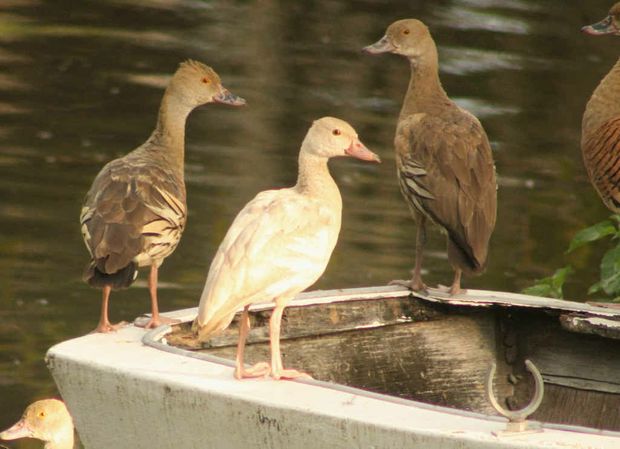
Pale duck brings in the birdwatchers

1st Jun 2015 5:00 PM

A VERY pale Plumed Whistling-Duck, which has been at a Waterview Heights dam for about a fortnight, has attracted the attention of local birdwatchers (birdos).

The duck was first observed by local resident Brian Scrivener on his dam, along with 300 or so normally coloured Plumed Whistling-Ducks.

UNIQUE: The pale bird has attracted the
 attention of local bird watchers
 and those from afar. Photo: Dr Greg Clancy
Brian advised Gina Hart of the National Parks and Wildlife Service who passed on the information, and photos, to local ecologist Dr Greg Clancy.

Dr Clancy visited the site on Monday evening with two visitors from Virginia, USA, who were on a wildlife tour with him.

Three other local birdos visited after that and on Sunday Greg again visited to obtain photographs, with his wife Val, Joan O'Shea and Warren and Thompson.

Brian is expecting other birdos to call in to see his special duck.

"The duck was originally thought to be an albino but it has yellow eyes and slight pigmentation of some feathers making it a leucistic bird," Dr Clancy said.

"Leucism is a genetic mutation where most of the melanin in the feathers of a bird is lacking but the bare parts such as eyes, bill and legs are normally coloured."

Keeping the birds away with gel

Odorous product being tested in housing estates facing bird menace

PUBLISHED ON JUN 1, 2015 5:44 AM

BY SAMANTHA BOH

A GEL that deters birds with its smell is the new weapon being tried out against the bird nuisance in two housing estates in the west.

The herb-based product from Japan is being tested in Bukit Batok and Choa Chu Kang by the authorities here.

Along a path in Bukit Batok Avenue 1, containers of the gel have been placed above five lamp posts, which are common roosting places for birds because of their broad and flat tops.

Not too far away, another trial is being conducted at Block 755 in Choa Chu Kang North 5. Rows of containers with the gel line the ledges on the sides of the block.