As regular CFZ-watchers will know, for some time Corinna has been doing a column for Animals & Men and a regular segment on On The Track... particularly about out-of-place birds and rare vagrants. There seem to be more and more bird stories from all over the world hitting the news these days so, to make room for them all - and to give them all equal and worthy coverage - she has set up this new blog to cover all things feathery and Fortean.

Monday, 26 May 2014

Researchers map the epic evolution of a 'ring species'

The Greenish Warbler, long considered an idealized example of a single species that diverged into two as it expanded its range, has a much more checkered family history than biologists previously realized.

Ring species are a continuous loop of related populations, each adapted to its local environment, with two terminal populations in the loop meeting but now unable to mate. But an in-depth genomic analysis published today in Nature by University of British Columbia researchers reveals that the Greenish Warbler's genetic migration through central Asia involved periods of geographic separation and hybridization.

"We've shown that the evolution of ring species is much more complex than the smooth and continuous divergence envisioned by the classic model," says UBC zoologist Miguel Alcaide, the paper's lead author.

Sunday, 25 May 2014

Rare Cahow bird spotted off Kerry coast

One of the world’s rarest birds — once thought extinct for over 300 years — has been spotted off the Kerry coast.

The Bermuda petrel, better known as the Cahow, was observed by crew members of the Celtic Voyager — the Irish Marine Institute’s research vessel.

The “astonishing” sighting of the endangered seabird took place off Kerry on Monday. Within hours, the Bermuda Audubon Society confirmed the report through data emitted by the bird’s electronic geolocator.

The medium-sized Cahow is the national bird of Bermuda.

It is currently being “laboriously brought back from the brink” by conservationists with only about 180 of the species known to exist.

A slow-breeding ground-nester, the bird was wiped out during the 1600s when colonisation of the North Atlantic island introduced species such as boars, cats, dogs and rats.

It was rediscovered on the island in 1951.

Haul of endangered birds seized in Bicol

The suspects and their illegal bounty are intercepted on a bus allegedly bound for Manila port, from where the animals would be sent off to different parts of the country and the world

Pia Ranada
Published 3:18 PM, May 22, 2014
Updated 3:18 PM, May 22, 2014


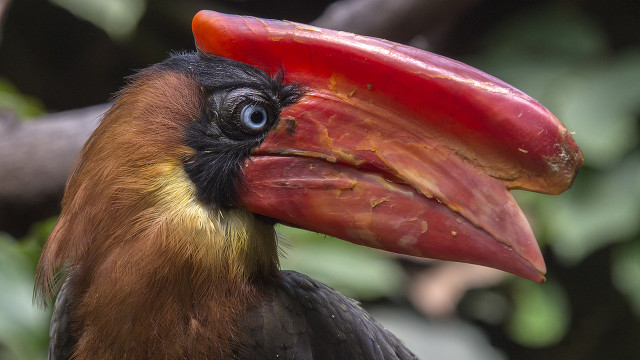
MANILA, Philippines – Environment officials confirmed that 7 rare birds were seized from a group of Filipinos allegedly en route to the Port of Manila on Tuesday, May 20.

The bird species seized were two Philippine hornbills, one Philippine hawk eagle, 3 raptors and one adult owl, said Department of Environment and Natural Resources Biodiversity Management Bureau chief Theresa Mundita Lim on Thursday, May 22.

The Philippine hornbill, also known as Rufous hornbill, is a critically endangered species under the International Union for Conservation of Nature (IUCN). The Philippine hawk eagle, meanwhile, is a vulnerable species.

The suspects and their illegal bounty were intercepted by the Highway Patrol Group Region 5 at Barangay Tabugon in the town of Santa Elena in Camarines Norte.

They were aboard a bus owned by bus franchise Twin Hearts which was allegedly on its way to Manila port from where the animals would be sent off to different parts of the country and the world.

All 7 birds were alive when they were discovered by cops in boxes inside the bus. The Philippine hornbills and raptors were found to be juvenile or very young birds.

Monofilament fishing line perilous for pelicans

Special to The News-Press12:06 a.m. EDT May 22, 2014

Fishing is an important part of the Florida lifestyle as well as its economy. In spite of the obvious benefits, this leisure-time activity, on occasion, can lead to problems for birds and other wildlife such as sea turtles and manatees.

According to the Florida Fish and Wildlife Conservation Commission biologists, monofilament fishing line and fishing hooks can entangle these animals, leading to injury and even death.

The brown pelican is one species that is especially affected by monofilament line. These birds frequently spend time looking for an easy meal at piers and other fishing hot spots, where they are often hooked accidentally when trying to grab bait off an angler's line. In addition, discarded monofilament line hanging from trees, piers and other structures can ensnare these birds. Once entangled, pelicans can have a difficult time flying and feeding.

"It is not uncommon to find dead pelicans entangled with fishing line and hooks," said FWC biologist Ricardo Zambrano. "If they are not rescued, these birds may suffer for days before succumbing to injury or starvation."

Here are some simple things people can do to help protect brown pelicans and other wildlife:

Hawk chicks rescued from nests near Sea-Tac runways


by GLENN FARLEY / KING 5 News

NWCN.com

Posted on May 21, 2014 at 6:17 PM

Updated Wednesday, May 21 at 6:47 PM

SEA-TAC INTERNATIONAL AIRPORT, Wash. — Imagine being 100 feet up in a tree and pulling chicks out of a nest. That may sound harsh, but it could keep your next flight at Sea-Tac from crashing.

Another spring, another pair of red tailed hawk chicks are rescued from a nest. Why? Because the birds are too close to Sea-Tac Airport’s runways.

Collisions are dangerous for people on planes and really bad for the birds.

John Mayet is an arborist – a tree guy, but he’s been handling these retrieval duties for years on behalf of biologists.

“We’ll take these (chicks) up north, we tag them all and that way we know if they’ve come back to the airport,” said Mayet.

Mikki Viehoffer is with the Port of Seattle’s wildlife program.


Bizzare: Bird Turns To Woman In Lagos

MATTHEW DIKE— May 22, 2014

A bizzare occurrence took place in Ajegunle area of Lagos State yesterday, when a bird that was flying in the sky, fell and transformed into an old woman.

Those who witnessed the incident which occurred on Ojo Road expressed shock at the development.

A witness who only gave his name as Emeka narrated that he was sitting in front of a compound with his lover when they saw three black birds in the air flying as if they were playing and he jocularly told his lover, Kemi that two of the birds could be male, fighting over the only female one. He said barely had they finished laughing over the joke when one of the birds fell and landed on a moving pick-up van belonging to the Eko Electricity Distribution Company, while the rest flew away.

Emeka said the bird then, fell on the floor and suddenly turned into an old woman, with blood gushing out of her forehead, as she rolled on the road.

He said a large crowd was attracted to the scene and the woman confessed to being a witch from Ibadan and that she came for a meeting in Lagos and was going back when the incident occurred.

The source said the woman told the bewildered crowd that they missed their way which was why they were hovering in the air till daybreak, adding that she fell because of tiredness.


Study offers snapshot of rare Ecuador Amazon parrot

23 May 2014 Last updated at 17:44

By Mark Kinver
Environment reporter, BBC News

UK researchers that headed to South America to learn more about one of the world's rarest parrots have returned with "more questions than answers".

A team from Chester Zoo spent three weeks studying Ecuador Amazon parrots.

The parrot was only reclassified as a species in its own right in December, before which it was deemed to be a subspecies of a common group of birds.

Only 600 individuals are estimated to remain in the wild, prompting the new species to be listed as Endangered.

"The truth is that we came back with far more questions than answers," explained expedition leader Mark Pilgrim, director general of Chester Zoo.

"Suddenly, there are a whole number of things that we didn't expect and we now have questions about."