As regular CFZ-watchers will know, for some time Corinna has been doing a column for Animals & Men and a regular segment on On The Track... particularly about out-of-place birds and rare vagrants. There seem to be more and more bird stories from all over the world hitting the news these days so, to make room for them all - and to give them all equal and worthy coverage - she has set up this new blog to cover all things feathery and Fortean.

Monday, 21 July 2014

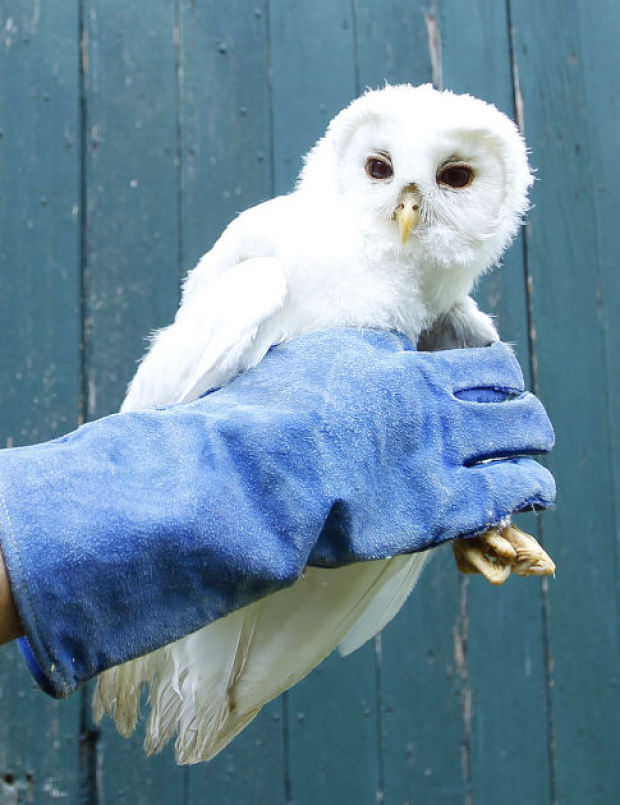
Rare albino barred owl found in Cedar Falls, taken to rehab center

July 18, 2014 5:30 am • ALISA HRUSTIC alisa.hrustic@wcfcourier.com
071714cc-owl-01CEDAR FALLS | A rare albino barred owl, picked up by animal control officers Saturday, is being nursed back to health by volunteers of the Black Hawk Wildlife Rehabilitation Project.
The bird was found along Main Street, a few blocks from his home nest, and left experts in awe at the sight of his completely white plumage.

When animal control called Linda Nebbe, a rehabilitation volunteer of about 40 years, she couldn't believe they had an all-white owl to bring her.

"I wanted to say 'yeah right,'" she said. "I've never seen anything like this."

Nebbe believes the owl became sick after eating something that clearly impacted his system.

"He started acting with a lack of control," she said. "He was very droopy and seemed not aware and didn't react to anything. I gave him some fluid and he was very dry."

The owl also was severely underweight, but is only a baby yet, and is improving already.

"Now he's eating well," Nebbe said. "We took him to the vet on Tuesday and she found him to be, from everything we could see, in good health."

read on

'Shoved' sea eagle chick on Mull flies nest

18 July 2014 Last updated at 21:28

A sea eagle chick, featured on BBC Springwatch, which was seen being pushed out of the nest by an intruder eagle has successfully flown the nest.

The young chick, which fell 30ft, was seen via webcam being shoved out of the Mull nest by another bird - behaviour never recorded in Scotland before.

It was returned to the nest by Forestry Commission Scotland (FCS) rangers.

Worried viewers noticed the nest empty again but it was confirmed that the chick fledged successfully on Thursday.

The three-month old was seen perched in nearby woodland and was flying strongly.

Dave Sexton, the RSPB's Mull officer, who has been monitoring the nest, said: "We were initially concerned as there was no sign of the chick and I couldn't hear her either which was unusual.

Sunday, 20 July 2014

Birdsongs automatically decoded by computer scientists


Date:
July 17, 2014

Source:
Queen Mary, University of London

Summary:
Scientists have found a successful way of identifying bird sounds from large audio collections, which could be useful for expert and amateur bird-watchers alike.


Duck migration study reveals importance of conserving wetlands


Date:
July 17, 2014

Source:
University of Missouri-Columbia

Summary:
During the 2011 and 2012 migration seasons, researchers monitored mallard ducks with new remote satellite tracking technology, marking the first time ducks have been tracked closely during the entirety of their migration from Canada to the American Midwest and back. The research revealed that mallards use public and private wetland conservation areas extensively as they travel hundreds of miles across the continent.


Revealed: The mystery behind starling flocks

Date:
July 18, 2014

Source:
University of Warwick

Summary:
The mystery behind the movements of flocking starlings could be explained by the areas of light and dark created as they fly, new research suggests. The research found that flocking starlings aim to maintain an optimum density at which they can gather data on their surroundings. This occurs when they can see light through the flock at many angles, a state known as marginal opacity. The subsequent pattern of light and dark, formed as the birds attempt to achieve the necessary density, is what provides vital information to individual birds within the flock.


Saturday, 19 July 2014

Fruit colours evolved to please picky birds

Tropical Asian birds have a penchant for red and black -- a proclivity that likely prompted jungle plants to sprout fruit in these colours, scientists said on Thursday.

It has long been suspected that an abundance of red and black fleshy fruits in nature was partly inspired by a pigment preference of the keen-eyed birds that eat them and spread the seeds.

A team in China decided to test the theory by determining once and for all whether birds do have colour favourites.

To eliminate possibly confounding influences of smell, shape or taste, the team manufactured artificial fruits from a mixture of apple, pear, banana, wheat and corn flour rolled into small balls and dyed black, red, yellow, green or blue using tasteless food colouring.

They then put the fruit balls in front of different species of bulbul and barbet birds native to tropical Xishuangbanna in southwest China.

The birds, both wild-caught and hand-reared, were left to choose for themselves what they wanted to eat.

All favoured red fruit, followed by black, the scientists found, and all avoided green ones, whose seeds in nature are generally dispersed by insects and other non-avian animals.

A Peacock Murder Mystery: (Pea)Fowl Play In California

by GLORIA HILLARD
July 15, 2014 5:16 PM ET

Someone is killing the peacocks in Rolling Hills Estates, Calif.

The boisterous and colorful birds have been a part of this upscale community near Los Angeles for more than a century. In recent years, the birds have become a source of contention among neighbors — but the conflict has taken a dark turn.

The string of peacock killings is now at 50 over the past two years or so — 20 in the past six months alone — by pellet guns, shotguns, arrows and poison.

Detective James Dondis of the Los Angeles County Sheriff's Department and Lt. Cesar Perea of the Society for the Prevention of Cruelty to Animals are investigating the attacks. "The violent manner in which some of the birds are being killed is a big concern," Dondis says. Investigators have some suspects, he says.

It's nearly impossible to avoid seeing — or hearing — the peacocks in Rolling Hills Estates, often perched in trees or on fences, or walking on driveways or lawns in this equestrian neighborhood. The birds seem to know the houses that are peafowl friendly — like Eunice Berman's. Two stroll in her backyard. One is on her roof. Another is lounging in a tree.

"Right now is probably the loudest season we have of them, because it's mating season, and they're calling around to each other," she says.

Berman says car alarms, gardeners, vacuum cleaners and earthquakes can set the birds off. She loves the peacocks but admits not everyone feels the same way. "They're slow crossing the street. They tend to be a little bit messy, and they eat vegetable gardens and certain plants," she says.