As regular CFZ-watchers will know, for some time Corinna has been doing a column for Animals & Men and a regular segment on On The Track... particularly about out-of-place birds and rare vagrants. There seem to be more and more bird stories from all over the world hitting the news these days so, to make room for them all - and to give them all equal and worthy coverage - she has set up this new blog to cover all things feathery and Fortean.

Friday, 25 December 2015

Rare Asian bird discovered off Scottish coast


27 November 2015 by Reporter
The Oriental Dove

It is normally found in the more exotic climes of Asia.
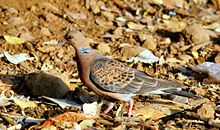
Orientalturtledove.JPGBut for only the twelfth time since records began, an Oriental Dove has been discovered thousands of miles off course in Shetland.

It was first spotted on Wednesday in a garden in Scalloway, the second time the species has been found on Shetland – the last in 1974 on Fair Isle – and the fifth for Scotland.

The dove is usually found in Russia, Japan, south-east Asia and the Indian sub-continent. Quite why this particular bird decided to veer off course is something of a mystery.

But Josh Jones of the authorative Bird Guides, said it could have been due to recent weather patterns.
“It is well off course – the nearest it usually comes is the Ural Mountains. But there is a good chance it may stick around for a while and could survive the winter and fly off again in the spring,” he said.


Wednesday, 23 December 2015

Fire Destroys 90 Percent of Rare Bird's Habitat in Australia

Only about 140 western ground parrots remained before last month’s devastating fires

By John R. Platt on December 3, 2015

One of the world’s most endangered birds faces an uncertain future this month after massive bushfires in Australia destroyed at least 90 percent of the species’ habitat.

Only about 140 western ground parrots (Pezoporus flaviventris) remained before the fires. The birds—one of just five ground-dwelling parrot species on the planet—depend on dense vegetation for their nests. Many of their known nesting sites were destroyed in fires that ripped through the region around Cape Arid National Park last month. The bushfires destroyed 30,000 acres of crops, killed four people, and burned 15,000 livestock animals to death.

Officials for Western Australia’s Department of Parks and Wildlife told the Australian Broadcasting Company that two “pockets” of the birds’ habitat did not burn and that automated recording devices indicate that an unknown number of the birds remain alive in those sections. Two birds—a male and a female—were rescued before fires completely overran the park and are now recovering at Perth Zoo, which already has five other parrots in their collection.

The fires also reportedly took a toll on the local population of another critically endangered species, a mouse-like kangaroo called the Gilbert's potoroo (Potorous gilbertii).

Fire is a normal part of the ground parrot’s ecosystem, although the birds prefer areas that have not been burned for at least 40 years and which have a high level of low-growing shrubs. The birds can fly, but they spend most of their time on the ground, so it seems unlikely that they could have escaped the flames that hit their nests.


Curlew should be priority species, says RSPB Scotland

3 December 2015

Curlews should be the highest conservation priority bird species in the UK, according to RSPB Scotland.

The UK has 27% of the world's breeding curlews but numbers of the wading birds have fallen by 43% since the mid-1990s, the charity said.

The RSPB made its call following a new report, Birds of Conservation Concern, which has listed curlews as a bird of "highest conservation concern".

The UK is thought to have about 68,000 breeding pairs.

Loss of habitat, climate change and predation are thought to have led to declining populations.

'Big impact'
Dan Brown, conservation adviser with RSPB Scotland and lead author of the new report, said falling curlew numbers was a "major concern".

He said: "We are responsible for more than a quarter of the world's population in the UK, so the large declines currently occurring may be having a big impact on the global population.

"On this basis, the curlew emerges as our highest priority species from a global perspective - conservation success in the UK will go a long way to helping secure the global population.

"We also approach this work acutely aware that, sadly, two close relatives of the Eurasian curlew - the Eskimo curlew and the slender-billed curlew - are highly likely to have become extinct in recent decades."


Rare whooping crane migrates to north Alabama


POSTED 2:57 PM, DECEMBER 2, 2015, BY MEGAN BRANTLEY, UPDATED AT 04:06PM, DECEMBER 2, 2015

DECATUR, Ala. – The International Crane Foundation is asking for your help to protect a rare breed of crane that has made its way to north Alabama. The whooping crane has been migrating to our region since 2003, but conservationists say many still don’t know they’re here.
“Whooping cranes are the rarest of the crane species,” said Lizzie Condon of the International Crane Foundation.

There are only 600 of these cranes left in existence, even fewer still in the wild.  “You can find them only in North America. Some of them are in Canada, but most of them are here in the United States,” said Condon.

One of the tallest birds in the world, the cranes stand five feet in height. 


Tuesday, 22 December 2015

Kestrel inspires unpowered, autonomous glider to climb higher

Date:December 18, 2015
Source:IOP Publishing

Researchers at the RMIT University, Melbourne, Australia have drawn inspiration from the way kestrels hover above their prey to develop an autonomous fixed-wing micro air vehicle (MAV) that can gain height from convenient updrafts.

The results are published Dec. 18 in the journal Bioinspiration & Biomimetics.

"It's long been known the birds take advantage of upward air currents to save energy when flying" explains Alex Fisher, a lead author of the paper. "This 'boost' of upward-moving air can be found when the wind hits a large obstacle, like a cliff or mountain range, and to a smaller extent close to human-made obstacles like buildings."

"We envisage that in the future, MAVs will be used for many tasks in urban environments, such as delivering packages, performing surveillance, and search and rescue" he continues. "Using these updrafts would make them more efficient and therefore extend their working range."

"If you're familiar with the kestrel, you may know they've got a unique way of hunting -- hovering over a location without flapping their wings. This allows them to keep their heads still with incredible precision, helping them spot prey on the ground. The preciseness at which they hold position led us to thinking we could try this 'wind-hovering' technique on our MAV."

The researchers used a commercially available polystyrene foam sail-plane as their test platform.

Darwin's finches may face extinction


Date:December 18, 2015
Source:University of Utah

Mathematical simulations at the University of Utah show parasitic flies may spell extinction for Darwin's finches in the Galapagos Islands, but that pest-control efforts might save the birds that helped inspire the theory of evolution.

The new study "shows that the fly has the potential to drive populations of the most common species of Darwin's finch to extinction in several decades," says biology professor Dale Clayton, senior author of the study published online Dec. 18 in the Journal of Applied Ecology.

But the research "is not all doom and gloom," he adds. "Our mathematical model also shows that a modest reduction in the prevalence of the fly -- through human intervention and management -- would alleviate the extinction risk."

Several approaches may be needed, such as introducing fly-parasitizing wasps, removing chicks from nests for hand-rearing, raising sterile male flies to mate with females so they can't lay eggs in finch nests, and using insecticides, including placing pesticide-treated cotton balls where birds can collect them to self-fumigate their nests.


New research shows decline in population and breeding success of Antarctic seabird

Date:December 21, 2015
Source:British Antarctic Survey

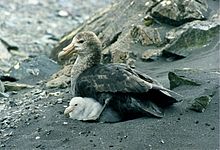
Giant petrel with chicks.jpgA fifty year study of the charismatic seabird, the southern giant petrel, on the Antarctic island of Signy shows its population has halved and its breeding success has declined in the last 10-20 years. The results by scientists at British Antarctic Survey (BAS) are published this month in the journal Polar Biology online.

Southern giant petrels are large, colonially-nesting seabirds with wingspans of over 2 m capable of long-distance ocean travel. They feed on prey ranging from crustaceans (including Antarctic krill), squid and fish at sea, to penguin and seal remains on land. Most birds breed for the first time only when they are between six and ten years of age, and they produce at most one chick per year.

Scientists have studied the giant petrels breeding at Signy Island -- in the South Orkney Islands (60°S) -- since 1968. Twenty years ago, a structured monitoring program was introduced to keep a closer track of numbers of breeding birds and how many chicks fledged each season. These surveys -- the most detailed on this species in the South Orkneys -- have now revealed that breeding success has declined substantially, from 60% in 1996 to 40% in 2015 in selected study colonies. Whole-island counts show that following an increase in breeding numbers from the mid 1980s to the mid 2000s, the population has halved from over 5800 to around 2600 nesting birds since 2005.