As regular CFZ-watchers will know, for some time Corinna has been doing a column for Animals & Men and a regular segment on On The Track... particularly about out-of-place birds and rare vagrants. There seem to be more and more bird stories from all over the world hitting the news these days so, to make room for them all - and to give them all equal and worthy coverage - she has set up this new blog to cover all things feathery and Fortean.

Wednesday, 11 March 2020

New tiny 44 million year old bird fossil links Africa and Asia to Utah

MARCH 3, 2020


A new species of quail-sized fossil bird from 44 million year old sediments in Utah fills in a gap in the fossil record of the early extinct relatives of chickens and turkeys, and it shows strong links with other extinct species from Namibia in Southern Africa and Uzbekistan in Central Asia.

In their paper in the online scientific journal Diversity, the authors Dr. Thomas Stidham (Institute of Vertebrate Paleontology and Paleoanthropology, Chinese Academy of Sciences), Dr. Beth Townsend (Midwestern University, Arizona), and Dr. Patricia Holroyd (University of California Museum of Paleontology, Berkeley) describe the fossil of a distinct tiny bone from the shoulder girdle of an extinct quail-like bird from 44 million year old rocks in eastern Utah. While it is a unique fossil, the authors have not given it a formal scientific name, waiting until they find more bones of the skeleton. This new Utah bird appears to be the oldest fossil of the extinct group called Paraortygidae, a relative of the living Galliformes (the group that includes the living chicken, turkey, guineafowl, and quail). This fossil fits in a nearly 15 million-year gap in the fossil record of the galliform lineage in North America.

This extinct species is similar in size to the smallest living Galliformes like quail and hill partridges. It likely lived before the evolution of the large crop and gizzard that we see in living chickens and turkeys, and therefore the Utah species likely had a diet different from its living relatives. The earliest fossils of this paraortygid group are from arid habitats, the seashore, and inland forests demonstrating that they had flexibility in their ecology and diet.

Another interesting aspect of this new fossil is that it closely resembles the small size and unique shape of other early paraortygid fossils from sediments with a similar geological age from Namibia in southern Africa and Uzbekistan in Central Asia which were all separated from each other by oceans.

The impact of energy development on bird populations

MARCH 6, 2020

by Wiley
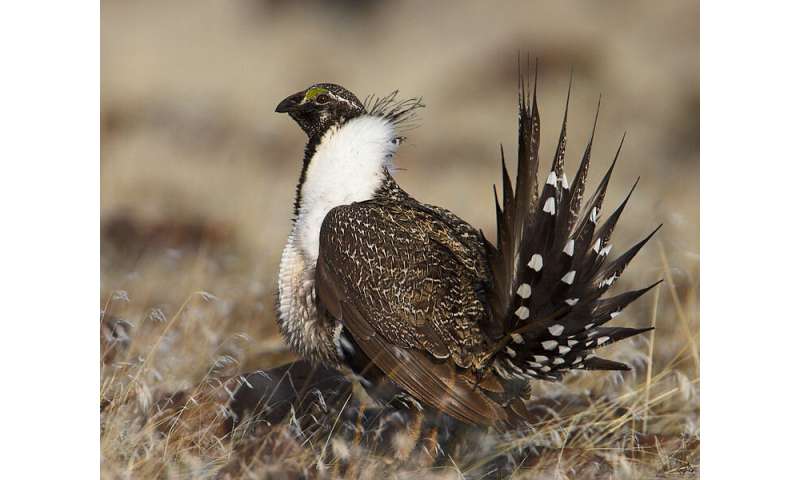
A  male Sage Grouse (also known as the Greater Sage Grouse) in USA. Pacific Southwest Region U.S. Fish and Wildlife Service from Sacramento, US

The greater sage-grouse is an iconic bird that lives in the western United States, and its populations are in decline. A new study published in the Journal of Wildlife Management reveals that energy development has negative impacts on sage-grouse reproduction.

The study's authors note that the full extent of such impacts on reproduction are not always realized because most female sage-grouse choose to nest and raise chicks in less disturbed areas, but only when these areas are still available to them.

The findings indicate that efforts are needed to avoid disturbing sage-grouse habitat when positioning renewable and non-renewable energy projects, and they highlight the complexities of balancing species conservation with energy development demands.

"Our study is unique in that instead of a commonly used metric for development intensity such as density of wells in an area, we delineated the actual footprint of energy development to measure the direct removal of sagebrush habitats for energy infrastructure, across several study areas," said lead author Christopher P. Kirol. "Our findings suggest that reproductive costs incurred by sage-grouse have a direct relationship to the footprint of energy development and this relationship holds irrespective of the type of energy infrastructure, whether natural gas or conventional oil, for example."

Monday, 9 March 2020

What birdsong tells us about brain cells and learning


Date: February 19, 2020
Source: University of Chicago

Most scientists who study the brain believe that memories are stored through networks of synapses, or connections that form between neurons. Learning takes place as neurons form new connections and strengthen or weaken existing ones, giving the brain its so-called synaptic plasticity. There is growing evidence, however, that the intrinsic, built-in properties of the cells themselves, not just the connections between them, also play a role in this process.

New research by neuroscientists at the University of Chicago uses a unique model -- the intricate mating songs of birds -- to show how these intrinsic properties are closely tied to the complex processes of learning. The study, published in Nature Communications, could add a new layer of complexity to our understanding of the brain.

"We are able to go directly from the properties of the cells to the behavior of the animal," said Dan Margoliash, PhD, a neurobiologist and senior author of the new study. "This suggests that it's not just rapid changes at synapses that are driving learning and memory, but changes in the intrinsic properties of cells as well."

Mosaic evolution painted lorikeets a rainbow of color

New study shows how color pattern evolution lets birds use bright colors for signaling while remaining hidden from predators

Date: February 26, 2020
Source: American Museum of Natural History

A new study examines how color evolved in one of the flashiest groups of parrots -- Australasian lorikeets -- finding that different plumage patches on the birds evolved independently through time. The study, published this week in the journal BMC Evolutionary Biology, helps explain why it's possible for the birds' faces and front sides to display a dazzling variety of colors -- from vibrant ultraviolet blue only visible to other birds to deep crimson and black -- while their wings and backs tend to be the same color: green.

"All birds need to balance being attractive to potential mates while having some kind of camouflage against potential predators," said Brian Smith, an associate curator in the American Museum of Natural History's Department of Ornithology and one of the co-authors of the new study. "So how do lorikeets, which have a very extreme appearance, get so colorful without being predated by lizards or hawks?"

To help answer this question, Smith and Jon Merwin, a Museum research assistant who began the project as a student at Columbia University, took visible-light and UV-light photos of 98 historic Museum specimens of Australasian lorikeets -- those that live in New Guinea, Australia, and surrounding archipelagos -- representing nearly all of the diversity in the group. Many birds can see in the ultraviolet spectrum, to which most humans are blind, so the researchers used a special program that translates color into "bird vision." They collected data from 35 plumage patches on the birds across the face, head, back, wings, breast, and lower abdomen. Those color data were modeled within the tree of life for lorikeets to test whether different patches of the birds are more likely to evolve under certain scenarios.

One species to four: New analysis documents new bird diversity in the Pacific

Date: March 6, 2020
Source: University of Maryland Baltimore County

In the 1930s, famed biologist Ernst Mayr became the first to study Pacific Robins. Based on his observations of the robins and other birds on Australia and its outlying islands, he developed foundational concepts that continue to inform the study of evolution. He took copious notes on the birds' physical characteristics, behaviors, and habitats. Always, he described the robin populations as a single species, albeit with significant variation from island to island.


Ernst Mayr made lasting contributions to evolutionary biology -- but like most scientists, he wasn't right about everything.

Bold new claims

Anna Kearns is a former UMBC postdoctoral fellow now at the Smithsonian Institution's Conservation Biology Institute. With her UMBC postdoc advisor Kevin Omland and other colleagues, she has conducted new investigations into the relationships among Pacific Robins on various islands using many of the same bird specimens Mayr himself used. The difference is, "He would have mainly been just using his eyes" to compare specimens, Kearns says. She and her colleagues have had the advantage of major advances in technology since Mayr's time.


Sunday, 8 March 2020

More than 600 vultures found dead in Guinea-Bissau


02/03/2020


Hundreds of vultures have been found dead in Guinea-Bissau over the past 10 days, according to the Vulture Conservation Foundation (VCF).

As of 28 February, the known death toll was placed at 648 – and this figure continues to rise in what represents a massive blow to the country's vulture populations.

Last week, an incident was reported in the eastern province of Bafatá, which was initially thought to have caused around 200 vulture deaths. However, the death toll subsequently increased substantially. Poisoning was initially thought to be the cause, given that this has become a frequent occurrence across Africa and is now recognised as posing the biggest threat to vultures around the continent.

André Botha, the Endangered Wildlife Trust Africa's Vultures for Africa Programme manager, said: "In recent years, we have unfortunately faced several incidents where hundreds of vultures died around a poisoned carcass, usually due to human-wildlife conflict with predators, we first thought this was such a case."


Pigeon fancier fined after killing sparrowhawk


23/02/2020

A pigeon fancier has been fined after killing a Eurasian Sparrowhawk with an air rifle.

Duncan Cowan, from Cowie in Stirlingshire, was ordered to cough up £450 at Stirling Sheriff Court as a result of the incident. On 18 April 2019, the raptor was spotted predating a pigeon in a field next to the 60-year-old's garden.

He was seen coming out of his shed with an air rifle before firing at the bird three or four times. Police were called before the Scottish SPCA took the injured sparrowhawk, which had lost a lot of blood, to their wildlife centre for treatment on a chest wound.